
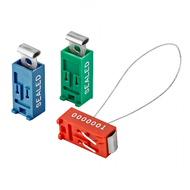
Why the PSW-97 Is One of the Best Wire Security Seals
Posted by Steve Diebold
The PSW-97 is widely regarded as one of the best wire security seals on the market because of its tool-free stainless steel locking plunger, compatibility with almost any wire type or length, and proven durability in outdoor conditions. A wire security seal is a tamper-evident device that uses wire threaded through a lock body to secure an opening, showing visible signs of damage if tampered with.
Wire security seals are among the oldest forms of tamper-evident sealing still in use today, relying on separate wire rather than a fixed strap or cable so length and material can be matched to the job. Common applications include utility meters, storage bins, cabinets, valves, drums, and trucks or trailers.
What Is a Wire Security Seal, and Where Is It Used?
A wire security seal is one of the oldest forms of tamper-evident sealing technology still used today. Instead of a fixed strap or cable, it relies on separate wire that is threaded through the seal body and locked in place, which means the wire length and material can be matched to the job at hand.
Common applications for a wire security seal include:
- Utility meters and metering devices
- Storage boxes and inventory bins
- Cabinets, lockouts, and coin boxes
- Valves, drums, and bulk containers
- Trucks, trailers, and railcars
Lead wire seals were once the standard, but health and handling concerns have pushed the industry toward plastic-bodied wire seals like the PSW-97, which pair a locking plunger with galvanized steel, stainless steel, or copper wire.
How the PSW-97 Locking Mechanism Works
The PSW-97 relies on a patented locking system developed by AC&M that makes it one of the most dependable wire security seals for tamper detection. From the lock design to field application, the process breaks down into a few key steps.
- The locking plunger engages by hand. A stainless steel plunger, sometimes called the key, presses into the plastic seal body by hand until it snaps into place. Once locked, the seal cannot be reopened without visible damage.
- The wire is field-selectable, not fixed. Since the wire is not permanently attached to the seal body, users can choose the exact wire type and length for each closure. AC&M supplies 3-ply and 4-ply galvanized steel, stainless steel, and copper wire, in pre-cut lengths or bulk rolls trimmed on site.
- Application requires no tools. The twisted wire threads through the two holes in the plastic body, and the plunger presses in by hand until an audible click confirms the lock. No crimping tool, wire cutter, or press is needed, which speeds up sealing and removes the need to store or replace a separate sealing tool.
- The lock cannot be reset once engaged. Once locked, the seal cannot be reopened or reused. Prying the plunger out, cutting the wire, or otherwise bypassing the lock leaves visible damage. That visible evidence, more than the lock's raw strength, gives the seal its tamper-evident value. Inspectors watch for cracks, bent plungers, or mismatched serial numbers as signs of tampering.
Together, these four steps explain why the PSW-97 remains a preferred choice for teams that need a wire security seal that is fast to apply, difficult to reset, and easy to inspect in the field.
What Makes the PSW-97 Different from Other Wire and Cable Seals
Buyers often compare a wire security seal to a cable seal, since both use a flexible line to secure a closure. The distinction comes down to strength and application. A cable seal typically uses a thicker, permanently attached steel cable and is built for higher-value or higher-risk shipments, while a wire security seal like the PSW-97 is lighter, faster to apply, and better suited to metering, storage, and general-purpose closures.
|
Feature |
PSW-97 Wire Seal |
Typical Cable Seal |
|
Wire or cable attachment |
Removable, field-selectable |
Fixed at the factory |
|
Tools required |
None |
Sometimes none, depending on model |
|
Breaking strength |
Approximately 45 kg (100 lbs) |
Often higher, model dependent |
|
Best suited for |
Meters, bins, drums, trailers |
Containers, tankers, high-value cargo |
Organizations that need a stronger option for international shipments or high-value freight often pair a wire seal with a cable seals supplier that can provide adjustable cable seals rated for ISO 17712 compliance, which is the international standard for high security seal testing. A high security seal is a seal that has passed independent strength testing for pull, bend, and shear resistance, and it is typically reserved for higher-risk cargo rather than metering or storage applications.
Material Options and Durability in the Field
Standard PSW-97 bodies are made from premium styrene plastic in opaque, transparent, or clear color options. For more demanding environments, AC&M also offers a solvent-resistant acetal polymer body. Both materials are built to show clear signs of tampering, including cracking or fracturing, if someone attempts to force the seal open.
The PSW-97 has been tested for continuous outdoor use, including exposure to rain, temperature swings, and other harsh weather. Despite its strength, which reaches nearly 45 kg (100 lbs) of breaking force, the seal can still be removed with common wire cutters when authorized personnel need access. This balance of strength and controlled removability is part of what makes a wire security seal practical for daily operational use rather than one-time, high-security applications only.
The body shape of the PSW-97 also allows for larger, more legible markings than many competing wire seals. Sequential numbers, letters, logos, and even multiple languages can be stamped onto each unit, which supports better inventory tracking and easier visual inspection.
Where the PSW-97 Fits in Truck, Trailer, and Cargo Security
Wire seals are frequently used alongside heavier sealing solutions for truck seals and trailer seals programs, particularly on lower-risk routes or as a secondary seal on compartments that do not require a full barrier seal. Cargo theft remains a significant and growing concern across North American supply chains. According to Verisk CargoNet's 2025 analysis, estimated cargo theft losses across the United States and Canada rose sharply year over year, driven by criminal groups increasingly targeting higher-value shipments rather than opportunistic theft.
This trend underscores why fleets and shippers often layer their sealing strategy, using a wire security seal for general-purpose closures like tank valves, hatch covers, and storage compartments, while reserving high security seal options for container doors and other high-risk access points. A well-planned seal program also supports better documentation, since each wire seal number can be logged and matched against a shipment record.
Choosing The Right Wire Security Seal for Your Application
Selecting the right wire security seal depends on a few practical factors:
- Opening size. Wire seals generally work best on closures with openings of 1mm or more, such as meter housings or bin latches.
- Wire material. Galvanized steel is a cost-effective standard option, while stainless steel and copper offer added corrosion resistance for harsher environments.
- Wire length. Because the PSW-97 accepts loose or pre-inserted wire, lengths can be customized rather than limited to a fixed factory size.
- Marking needs. Sequential numbering, custom text, and logos all support chain-of-custody tracking.
- Environment. Outdoor, high-moisture, or extreme-temperature settings may call for the acetal polymer body over standard styrene.
Working with an experienced security seals supplier can help match the right seal type, material, and marking configuration to the specific closure being protected, rather than defaulting to a one-size-fits-all product. For applications tied to metering and measuring equipment specifically, it also helps to review how wire seals for metering devices are typically specified, since utility and inspection requirements can differ from general storage use.
Cost is another factor worth weighing. A wire security seal is generally less expensive per unit than a cable or bolt seal, which makes it a practical choice for operations that seal a high volume of low-to-moderate risk closures on a routine basis. Reserving higher-cost, higher-strength seals for shipments that genuinely need that level of protection helps control sealing costs without weakening security where it matters most.
Choosing a Reliable Wire Security Seal for Long-Term Use
A wire security seal only performs as intended when it is paired with the right wire type, applied correctly, and inspected consistently in the field. Recognizing a cracked body, a bent plunger, or a mismatched serial number is what separates routine sealing from a program that actually deters tampering.
American Casting & Manufacturing has manufactured tamper-evident security seals, including the PSW-97, since 1910, offering hands-on guidance on wire selection, locking, and inspection whenever a customer needs it. Read more about our company history, or reach out directly to talk through your sealing program.