
What Is CTPAT Compliance and How Do You Maintain It?
Posted by Steve Diebold
CTPAT compliance refers to participation in the Customs Trade Partnership Against Terrorism, a voluntary supply chain security program managed by U.S. Customs and Border Protection (CBP). Companies that achieve CTPAT compliance agree to implement defined security practices across their supply chains in exchange for significant operational benefits, including reduced cargo inspections and priority border processing. Understanding what CTPAT requires, who qualifies, and how to stay certified is essential for any importer, carrier, or logistics operator moving goods across U.S. borders.
Launched in November 2001 in response to the September 11 attacks, CTPAT has grown from an initial group of ten major importers to more than 11,400 certified partners today. Those partners now account for over 52 percent of all cargo imported into the United States by value. That scale reflects just how central CTPAT compliance has become to modern cross-border trade.
What Is CTPAT?
CTPAT is defined as a public-private partnership between CBP and members of the international trade community. Its purpose is to strengthen supply chain security, reduce the risk of terrorism being embedded in commercial cargo, and maintain the efficient flow of legitimate trade across U.S. borders. The program is voluntary, meaning companies are not required by law to participate. However, the benefits of participation make it a practical priority for most serious trade operators.
When an entity joins CTPAT, it agrees to work with CBP to identify security gaps, implement specific protective measures, and uphold best practices throughout its supply chain. Applicants must address a wide range of security topics and submit a supply chain security profile that outlines how minimum security criteria are being met. For a broader overview of how tamper-evident tools fit into these requirements, the Guide to Tamper Evident Security Seals is a useful starting reference.
Who Is Eligible for CTPAT Membership?
CTPAT membership is open to twelve categories of business entities operating within the U.S. trade community. Eligible entity types include:
- U.S. importers and exporters
- U.S./Canada and U.S./Mexico highway carriers
- Rail and sea carriers
- Licensed U.S. Customs brokers
- U.S. marine port authority and terminal operators
- U.S. freight consolidators
- Ocean transportation intermediaries and non-operating common carriers
- Mexican and Canadian manufacturers
- Mexican long-haul carriers
- Air carriers and third-party logistics (3PL) providers
If your organization operates in any of these categories and moves goods through U.S. ports of entry, CTPAT compliance is worth pursuing. Reviewing the CBP's Minimum Security Criteria guide for your specific entity type is the recommended first step in confirming eligibility.
The Benefits of CTPAT Compliance
The benefits of CTPAT compliance are concrete and measurable. CBP classifies certified members as low-risk trade partners, which unlocks a range of operational advantages that non-certified companies do not have access to. For industries like cargo, freight, and logistics, these advantages translate directly into faster border crossings, fewer inspection delays, and stronger relationships with trade partners. Key benefits include:
- Reduced CBP examinations: Certified partners face fewer routine cargo inspections at ports of entry.
- FAST Lane access: Free and Secure Trade (FAST) Lane access at land borders significantly reduces border wait times for compliant carriers.
- Assigned Supply Chain Security Specialist: A dedicated CBP specialist is assigned to each certified partner to provide guidance and ongoing support.
- Priority inspection and business resumption: In the event of a natural disaster or terrorist attack, CTPAT members receive priority consideration to resume operations faster than non-members.
- Access to training and resources: Members gain access to CBP workshops, special training materials, and the CTPAT web portal.
- Trusted trade partner status: Certification is recognized by foreign customs administrations, supporting smoother international trade relationships.
- Eligibility for additional programs: Certified partners may qualify for the Importer Self-Assessment Program (ISA) and other U.S. government pilot programs.
How the CTPAT Tier System Works
CTPAT compliance is structured around a three-tier system. Each tier reflects the depth of a company's security practices and its level of engagement with CBP requirements. The tier a company reaches determines the degree of benefits it receives.
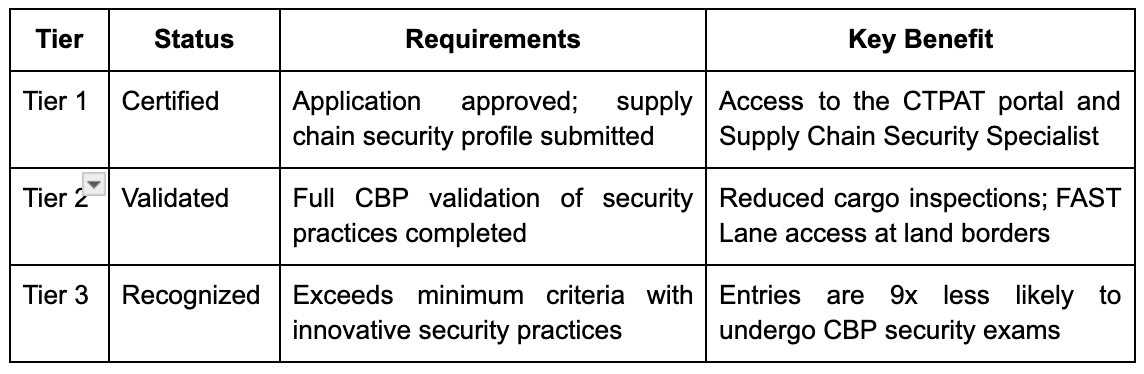
Tier 3 status is the highest level of recognition within the program. Companies that achieve it demonstrate a proactive, innovation-driven approach to supply chain security that goes beyond the minimum criteria. Tier 3 entries are nine times less likely to undergo a CBP security exam. Reaching this level requires robust documentation, ongoing risk assessments, and consistent engagement with your assigned Supply Chain Security Specialist.
How to Apply for CTPAT Certification
The CTPAT application process is conducted entirely online through the CTPAT Trade Compliance Portal, and it does not require an intermediary. CBP estimates the process takes an average of 20 hours to complete. Here is a step-by-step breakdown:
- Review the Minimum Security Criteria guide for your entity type to confirm eligibility.
- Submit a basic application through the CTPAT Portal and agree to voluntary participation.
- Complete a supply chain security profile explaining how your organization meets minimum security criteria. A risk assessment must be conducted beforehand.
- A Supply Chain Security Specialist reviews your submission. CBP then has up to 90 days to certify your company or reject the application.
- If certified, your organization will be validated within one year of receiving certification.
There is no fee to join the program, and no legal intermediary is required. That said, the application demands thorough preparation. Documentation, security procedures, and risk assessments must all be in place before submission. Understanding how cargo theft prevention factors into your security profile early on can strengthen the quality of your application.
What CTPAT Compliance Requires Today
CTPAT requirements have evolved significantly in recent years. Organizations that achieved certification years ago need to confirm their programs align with current CBP standards. Several updated requirements now apply to certified partners:
- Cybersecurity standards: CBP updated minimum security criteria in 2019 to include cybersecurity protections, safeguarding data systems and shipment records from unauthorized access.
- Social compliance requirements: Certified partners must have policies protecting workers' rights within their supply chain. This includes prohibiting forced labor, maintaining safe working conditions, and ensuring fair wages.
- Forced labor documentation: CTPAT now requires supply chain mapping, a code of conduct, and remediation plans to identify and address forced labor risk at any point in the supply chain.
- Business partner security: Partners must evaluate the security practices of their suppliers and subcontractors, not just their own internal operations.
- Incident reporting: Security incidents, cargo discrepancies, and suspected violations must be reported to CBP, typically within 30 days of discovery.
Maintaining CTPAT compliance also involves preparing for periodic revalidations, which may be conducted virtually or in person. During revalidations, CBP places significant emphasis on documentation, including visitor logs, container inspection records, and seal logs. A structured security seal verification and inspection program helps ensure your records are audit-ready at every stage.
The Role of Physical Seals in CTPAT Compliance
Physical cargo security is a foundational element of CTPAT compliance. Container and trailer integrity is a specific area of focus within the minimum security criteria, and CBP requires that certified partners implement procedures to ensure cargo remains secure from the point of loading through to final delivery.
High-security seals are the primary tool used to meet this requirement. ISO 17712 refers to the international standard that defines the testing and classification requirements for freight container seals. CTPAT compliance requires the use of seals that meet this standard for containers crossing international borders. Seals classified under ISO 17712 are rated as indicative, security, or high security depending on their resistance to tampering.
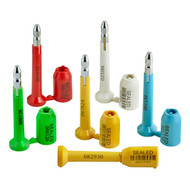
Bolt seals are the standard choice for ISO 17712-compliant container security. Constructed from hardened steel, they are designed to resist cutting and tampering, must be removed with specialized tools, and create clear evidence of any breach. For applications where a bolt seal is not practical, cable seals provide a flexible, tamper-evident alternative across a range of container types and transit vehicles.
For high-risk shipments, including international containers and long-haul trailers, C-TPAT compliant high security seals that meet ISO 17712 standards are the appropriate choice. These seals are available with custom printing and barcoding, making it easier to maintain accurate seal logs throughout the supply chain.
Seal logs are a critical component of CTPAT documentation. Carriers and importers must record seal numbers, application points, and inspection results at each handling stage. This documentation creates the audit trail that CBP reviews during validation and revalidation.
Maintaining Compliance After Certification
Achieving CTPAT certification is the beginning of an ongoing commitment, not a one-time milestone. Maintaining compliance requires consistent attention to security practices, documentation, and program updates. Key practices for sustained compliance include:
- Review program updates regularly: CBP issues updates to the Minimum Security Criteria and the CTPAT Trade Compliance Handbook. Organizations should review these updates and adjust their programs accordingly.
- Conduct internal audits: Periodic internal reviews of security procedures, documentation, and supplier practices help identify gaps before a CBP revalidation.
- Train employees consistently: Security awareness training is a mandatory requirement. Employees must understand CTPAT security guidelines, incident reporting procedures, and their individual role in maintaining program integrity.
- Maintain accurate seal logs: Container and trailer seal records must be current, organized, and accessible for audit. Following established best practices for sealing programs helps ensure your procedures hold up under CBP scrutiny.
- Prepare for revalidation proactively: Whether virtual or in person, revalidations assess documentation, personnel readiness, and the consistency of security practices across the operation.
Building a More Secure Supply Chain Through CTPAT
CTPAT compliance is one of the most effective steps a trade organization can take to protect its operations, reduce inspection delays, and demonstrate a genuine commitment to supply chain integrity. The program provides a structured framework for identifying security risks, implementing protective measures, and maintaining the documentation CBP requires.
For importers, carriers, and logistics operators, meeting CTPAT requirements starts with the right physical security tools. American Casting and Manufacturing has supplied ISO 17712-compliant bolt seals, cable seals, and high-security seals to CTPAT-certified partners for over 110 years. From seal selection to custom printing and barcoding, AC&M provides the products and expertise to support every element of your cargo security program. Staying compliant means staying current. Regularly reviewing updated CBP criteria, training your team, and working with a trusted sealing partner ensures your program holds up through every revalidation cycle.