
Tanker Security Starts With the Seal: A Field Guide for Fleet Operators
Posted by Steve Diebold
When a loaded tanker leaves a facility, changes hands, and arrives at its destination, someone has to confirm that nothing was opened or tampered with along the way. That confirmation comes from seals. Tank truck seals are tamper-evident devices applied to valves, hatches, and closures to detect whether any access occurred after loading, inspection, or handoff. Their job is not to stop a determined person from getting in. Their job is to make any access visible and remove all ambiguity about whether a closure was disturbed.
This guide is not about regulations or seal specifications. It’s about how to build a sealing program that actually works in the day-to-day reality of tanker operations. Product integrity, liability exposure, and chain of custody all depend on whether your seals are applied, inspected, and documented correctly at every point where the tanker changes hands, gets serviced, or sits unattended between stops.
Where Seals Are Applied in a Tank Truck Operation
Before addressing how to run a sealing program effectively, it helps to map where seals actually appear in a typical tanker workflow. The answer is more places than most operators initially consider.
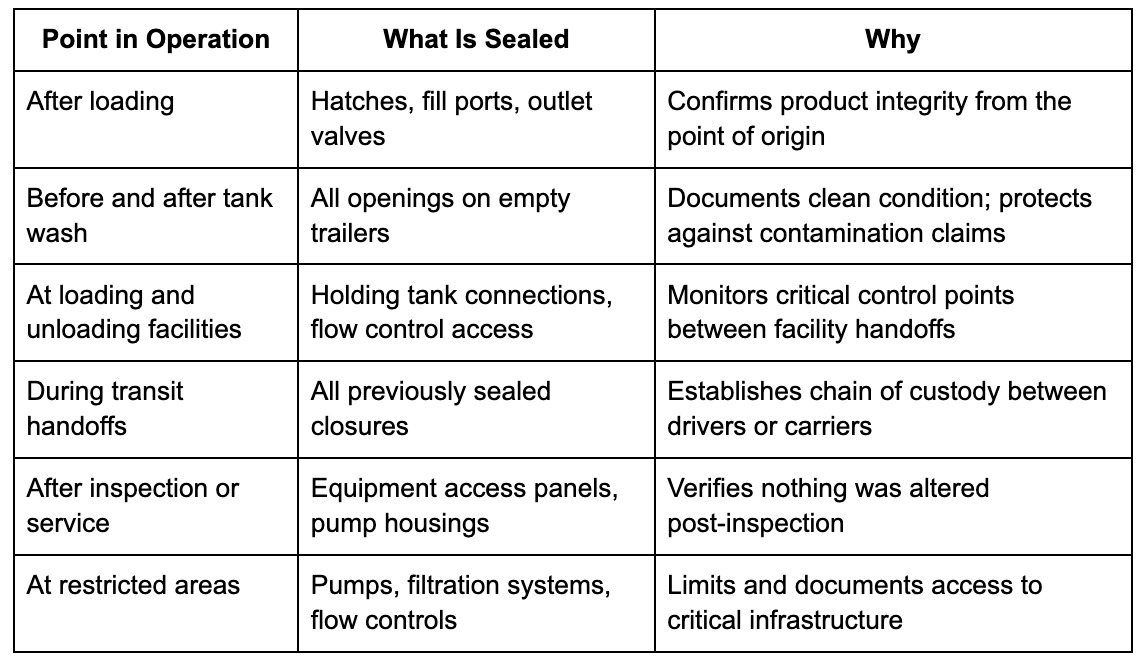
Each of these points is a moment where a seal either confirms continuity or flags a break in it. The more of these points that are covered and documented, the fewer opportunities exist for unreported access to go undetected.
What Seals Actually Do and Do Not Do
This is the part that gets glossed over in most sealing discussions, and it matters. Setting realistic expectations for a seal program is not pessimism. It’s the foundation of a program that actually holds up.
A seal cannot physically prevent a motivated person from accessing a valve, hatch, or closure. Anyone with the right tools and enough time can defeat a seal. What a seal does is make that access visible. It creates a record of disturbance that either appears during inspection or does not. If it does not appear, the seal tells you the closure has not been touched. If it does appear, you know exactly where and roughly when the breach occurred.
That is the correct frame for evaluating your sealing program. Not: “Did the seal stop access?” But: “Did the seal detect access, and did your program catch it?”
Everything else in a tanker sealing program is built around making that detection faster, more reliable, and harder to circumvent. For a deeper look at how to structure that program from the ground up, the Guide to Tamper Evident Security Seals is a solid reference point.
The Human Factor Is Not Optional
Technology is only half the equation. The most important variable in any sealing program is the people who apply and inspect the seals. A seal that is applied incorrectly provides no useful evidence. A seal that is inspected casually provides no useful evidence either.
This is the part of tanker sealing that most operators underinvest in. They select the right seals for trucks and tankers, apply them consistently, and then assume the program is working. But if the person opening a hatch does not know what an intact seal looks like, or does not know what to do when one is missing or damaged, the seal is providing security theater rather than actual detection.
Training is not a one-time event. Procedures need to be reviewed regularly, especially when personnel change. Every person who handles a sealed tanker, from the driver to the receiving facility operator, needs to know three things:
- What a correctly applied seal looks like for each closure point on that vehicle.
- What to do if a seal is missing, damaged, or shows any sign of disturbance.
- Who to report it to and what the consequences of not reporting are.
That last point is critical. A culture where unreported anomalies are tolerated is a culture where tampering goes undetected. Posting warnings about unreported seal issues and following through when they occur is a visible deterrent that costs nothing but carries significant operational weight.
Building a Program That Actually Detects Tampering
A seal sitting on a valve is inert without the program around it. Here is what a working tanker sealing program looks like in practice.
Make sealing standards visible. Post pictures of what correctly applied seals look like at each closure point. Display these in driver briefing areas, loading docks, and receiving stations. When people know what “correct” looks like, they can recognize “incorrect” immediately.
Use serialized seals and log them. Every barcoded or serialized seal applied to a tanker should be logged at the point of application: seal number, location, date, time, and the name of the person who applied it. When the tanker arrives at its destination, the seal numbers on the vehicle should match the log exactly. A mismatch is a flag. A missing log entry is a flag. Neither should be ignored.
Vary your seals when the situation warrants it. If you have experienced suspected tampering or you operate in a high-risk corridor, rotating seal colors, styles, or markings periodically adds a layer of unpredictability. Someone attempting to pre-position a replacement seal cannot do so reliably if they do not know what color or model will be used. Think of it the same way you would think about rotating passwords on sensitive systems.
Layer seals on high-value or high-risk loads. A single seal on a hatch is one point of failure. Two seals of different types applied to the same closure create two independent records of disturbance. For hazardous materials, fuel, or food-grade liquids where contamination or theft carries serious liability, layering is a straightforward risk reduction measure. AC&M's full range of plastic security seals and cable seals gives operators the flexibility to layer different seal types on the same closure point.
Inspect at every handoff, not just at the destination. Seal inspection should happen at each change of custody. If a seal is found damaged or missing at a receiving facility, it’s nearly impossible to determine where in the chain the breach occurred. Inspections at each handoff create a timeline that makes the investigation far more precise.
What to Do When a Seal Anomaly Is Found
Finding a damaged, missing, or mismatched seal is not a failure of the program. It’s the program working exactly as intended. What happens next determines whether the detection is useful.
The steps are straightforward, and they should be written down and posted at every point in your operation where seals are inspected:
- Do not open the closure. Treat it as compromised until documented and reviewed.
- Photograph the seal and the closure before touching anything.
- Record the seal number (or its absence), the closure location, the vehicle ID, and the time of discovery.
- Notify the appropriate supervisor or security contact immediately. Do not wait.
- Follow your organization's incident response procedure, including carrier notification, shipper notification, and any regulatory reporting requirements that apply to your product type.
Following established best practices for sealing programs means having this procedure documented before an anomaly occurs, not after. The difference between a well-handled incident and a serious liability event often comes down to whether there was a plan in place.
Choosing the Right Seals for Tanker Applications
Seal selection for tanker operations is not one-size-fits-all. Different closure types, operating environments, and security requirements call for different seal formats. The Security Seal Verification and Inspection Program Guide covers how to match seal types to specific inspection requirements, but a few general principles apply to tanker fleets specifically.
For hatches and fill ports where a simple pull-tight or strap seal is sufficient, the priority is serialization and visibility. A seal that can be read without touching the closure saves inspection time and reduces the chance of disturbing an intact seal during verification.
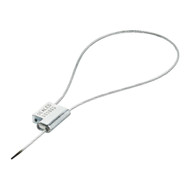
For valve outlets and high-risk closures, a heavier-duty option, such as a cable seal with a metal locking body, provides a stronger physical indicator while still being one-time-use and clearly tamper-evident. The goal is matching seal strength to the consequence of a breach at that specific point, not defaulting to the same seal across every application.
The Program Is the Product
A seal on a tanker is only as effective as the program surrounding it. The hardware matters, but it’s the procedures, the training, the documentation, and the inspection discipline that determine whether your sealing program actually protects your operation.
American Casting & Manufacturing has served tank truck fleets, processors, and refineries for over a century. Whether you are building a sealing program from scratch or evaluating what you already have, the team is available to advise on seal selection, application methods, and program design for your specific operation.