
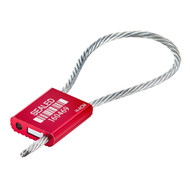
Tamper Evident Seals: The First Line of Defense for Cargo Shipping
Posted by Steve Diebold
A shipment rarely stays in one set of hands from origin to destination. It gets loaded, checked, handed to a carrier, transferred at a hub, inspected at a border crossing, and received at a facility where someone signs for it without having seen where it came from. At each of those points, there’s an opportunity for something to go wrong, and without a physical record of whether the cargo was accessed, there is no reliable way to know if it did.
Tamper evident seals are defined as one-time-use security devices that provide visible evidence of any unauthorized access to a shipment, container, or closure. Once applied, they cannot be removed and reattached without leaving clear signs of disturbance. That single function, creating an undeniable record of access, is what makes them the most practical and cost-effective tool available for protecting cargo in transit.
The Problem With Relying on Trust Alone
Most cargo theft and tampering does not happen in dramatic ways. It happens in the gaps: during a layover, at an unattended loading dock, during a handoff where neither party closely inspects the load. By the time the shipment reaches its destination, pinpointing where something went wrong, or even confirming that something did go wrong, can be nearly impossible without a documented record at each stage.
Liability adds another dimension to the problem. When a shipment arrives short, contaminated, or damaged, the question of responsibility depends heavily on whether anyone can show where the chain of custody broke down. Without seals and seal logs, that question rarely gets a clean answer. With them, the breach and the point at which it occurred becomes a matter of documented fact rather than disputed claim.
This is the practical case for tamper evident seals in cargo shipping. Not just as a deterrent, but as evidence. A seal that has been disturbed tells you something happened. A seal that remains intact tells you it did not. That clarity has real value at every stage of the supply chain, from the shipper managing liability exposure to the carrier protecting its reputation to the receiver confirming product integrity.
Layering: Why One Seal Is Not Always Enough
For routine shipments with a short, simple chain of custody, a single serialized seal on a closure is often sufficient. But for high-value loads, sensitive goods, long transit routes, or shipments crossing multiple jurisdictions, a layered approach provides meaningfully stronger protection.
Layering refers to the practice of applying more than one type of security tool to the same shipment. The combinations are flexible and should reflect the specific risks of the load. Common layering approaches include:
- A plastic security seal on the closure is combined with security tape or tamper evident labels across seams or access points so that both must be defeated to access the cargo without detection.
- Multiple seals of different types on the same closure, creating two independent records of disturbance rather than one.
- Barcoded seals that tie each physical seal to a digital log entry, enabling instant verification at any inspection point along the route.
- Customized seals with printed serial numbers, logos, or color coding that are specific to the shipment, making pre-positioned replacements far harder to source.
The goal of layering is not complexity for its own sake. It’s to raise the cost and difficulty of undetected tampering to the point where it becomes impractical, while simultaneously creating more documentation at each stage of the journey. For more on structuring this kind of program, the best practices for sealing programs guide covers the procedural side in full.
Serialization Turns a Seal Into a Paper Trail
A tamper evident seal without a serial number is a one-time indicator. A tamper evident seal with a unique serial number, logged at the point of application and verified at every subsequent handoff, is a chain of custody document. That distinction matters significantly when something goes wrong.
When seals are serialized and documented correctly, the record they create answers the questions that matter most after a tampering incident: which closure was accessed, at what point in the transit the seal was still intact, and where the first discrepancy appeared. That information determines liability, shapes the investigation, and in many cases is what an insurer or regulator will ask for first.
AC&M offers customized seals in a range of formats, including printed serial numbers, consecutive numbering, logos, and color options. Whether your operation uses cable seals on container doors, padlock seals on access hatches, or security tape on shrink-wrapped pallets, serialization can be built into the seal itself. Pairing that with a documented security seal verification and inspection program turns each sealed shipment into a verifiable record from departure to delivery.
The Most Cost-Effective Protection in the Supply Chain
Tamper evident seals are among the least expensive tools available for cargo protection, particularly relative to the cost of a single theft, contamination claim, or liability dispute. The investment is in the program around them: the logging, the inspection discipline, the training, and the procedures that ensure a seal anomaly gets caught and acted on rather than overlooked.
American Casting & Manufacturing has been manufacturing tamper evident seals and security seals for over 110 years. The full product range covers every format used in cargo shipping, from cargo, freight, and logistics seals to high-security options for regulated or sensitive loads. If you need help matching the right seal type to your shipping application, the AC&M team is available to advise.