
Security Seals Explained: Types, Standards, and Best Practices
Posted by Steve Diebold
Security seals help protect goods, assets, and sensitive materials across many industries, including logistics, utilities, healthcare, manufacturing, retail, and banking. Their main purpose is to provide clear evidence if an item has been accessed, strengthening accountability during handling, storage, and transport. Although seals may look simple, they play a serious role in security systems by reducing uncertainty and improving control. Many teams feel overwhelmed by the wide range of seal types and features, especially since different environments carry different risks and compliance expectations. When seals are selected without a clear plan, inspection often becomes inconsistent and creates gaps that can hide tampering.
This guide explains security seals in a practical and approachable way, focusing on what they are designed to do and how they fit into real workflows. The goal is to support informed judgment, rather than promote a single product, so you can choose solutions that match your operational needs. You will learn how to compare seal types, understand key standards, and recognize common tampering risks. You will also learn how to build procedures that improve detection and strengthen accountability across teams. When applied correctly, security seals become part of a dependable system of trust, documentation, and oversight.
The Intended Purpose of Security Seals and Their Practical Limitations
Security seals are designed to deter unauthorized access by providing clear, visible evidence of tampering, which is the core function of tamper evident seals. Most seals are single-use devices that must be broken or permanently altered to open the secured item, and that damage is intentional. It serves as a signal that access has occurred and should be reviewed. Unlike locks, security seals are not meant to guarantee prevention in every situation. Their primary value lies in detection, documentation, and accountability, rather than absolute physical resistance.
The effectiveness of a security seal depends entirely on whether it is inspected. A seal that is applied but never checked cannot deliver deterrence or accountability. Improper application can also create false confidence, especially when seals are loosely routed, poorly positioned, or mismatched to the closure. In these cases, access may occur without obvious damage, undermining the purpose of the seal. Correct application and consistent inspection are essential to ensuring that seals perform as intended.
For this reason, security seals should be viewed as part of a repeatable inspection system, rather than as standalone products. Their value increases when they are integrated into defined workflows, documented consistently, and checked at clear control points. Organizations that treat sealing as a process, supported by training and accountability, achieve more reliable results than those that treat seals as simple accessories. When used with discipline, even basic seals can play a meaningful role in reducing risk and supporting investigation.
Types of Security Seals and When to Use Them
Security seals are commonly grouped into three functional categories based on performance expectations and typical use cases. These categories help organizations align seal selection with risk level, inspection needs, and operational realities.
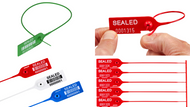
- Indicative seals are designed primarily to show evidence of access and are typically lightweight, easy to apply, and quick to inspect, such as pull-tight plastic seals commonly used for meters and storage containers. These seals work well in low-risk environments where visibility, discipline, and frequent inspection provide effective control. Their strength lies in clarity, rather than resistance.
- Security seals offer moderate resistance to tampering, while still supporting efficient workflows, making them well suited for environments with higher handling volume or increased risk of interference. In many commercial and industrial settings, plastic security seals are commonly used because they balance deterrence with ease of application and inspection.
- High-security seals are designed to resist significant force and are typically used in higher-risk scenarios, such as international freight or regulated cargo movements, where barrier security seals provide an added layer of physical deterrence, including options like the heavy duty bolt seal model PBLT2.
In practice, the right seal is the one that matches the risk level, workflow, and inspection discipline of the environment. Indicative, security, and high-security seals each serve a purpose, but effectiveness depends on consistent application and inspection, rather than maximum strength alone. When seal selection supports how people actually work, accountability improves and tampering becomes harder to overlook.
Understanding ISO 17712 Classifications Without Overreliance
ISO 17712 provides a standardized framework for classifying certain types of security seals based on performance testing, primarily related to strength and resistance. The standard defines classifications such as indicative, security, and high security, allowing organizations to compare seals using consistent terminology. Certified testing helps validate that a seal meets specific benchmarks and supports procurement and audit requirements.
However, ISO 17712 should be treated as guidance, not a decision engine. A high-security classification does not guarantee suitability for every workflow, closure, or environment. A seal may meet strength requirements, yet still perform poorly if it is difficult to inspect, incompatible with the closure, or prone to misuse. Conversely, an indicative seal can be highly effective when paired with disciplined inspection and clear procedures.
Standards work best when supported by training, documentation, and consistent handling. Certified seals can still fail in practice if they are stored improperly, applied incorrectly, or inspected inconsistently. ISO alignment adds credibility and structure, but real-world performance depends on how well the seal fits the process it supports.
Best Practices for Detecting Tampering and Supporting Accountability
Effective tamper detection relies on structured inspection and clear expectations, rather than intuition. Security seals only create value when they are checked consistently and supported by defined response procedures. The following best practices help organizations detect irregularities, reinforce accountability, and reduce the risk of unnoticed tampering.
- Establish mandatory inspection checkpoints: Inspection should occur at predefined moments, such as handoffs, transfers, and access events. Before a secured item is used or released, the seal should be verified for presence, condition, and consistency with records. If a seal is missing, broken, or irregular, the workflow should pause until the issue is reviewed.
- Standardize inspection expectations and response actions: Inspection must be fast, repeatable, and taken seriously. Staff should be trained to recognize correct placement, routing, and expected identifiers at a glance. Clear escalation rules ensure irregularities are addressed promptly rather than ignored or passed along.
- Support detection with consistent documentation: Documentation narrows investigation windows and reduces ambiguity. Numbered or barcoded seals help deter substitution and support verification. Records should be simple to complete and structured to support audits or investigations.
When these practices work together, security seals become dependable tools for detection and accountability rather than symbolic controls.
Building a Reliable Sealing Program Through Process and Discipline
Security seals only perform well when supported by people and processes. Training should explain not only how to apply a seal, but why it matters, so staff understand how different products function in real workflows, including options like bolt seals used in higher-risk applications. When teams recognize the purpose behind sealing, shortcuts become less common and consistency improves, especially when ownership for inspection and response is clearly defined.
A reliable sealing program treats documentation as a routine step, not an optional task. Seal identifiers, access events, and inspection checks should be recorded consistently across shifts and locations, whether the seal requires rigid placement or flexible routing, such as wire seals and wires used on irregular closures. The system should support quick review and accountability, because when documentation is optional, accountability becomes optional as well.
Programs should also be reviewed and reinforced regularly. Audits, refresher training, and feedback from frontline staff help identify friction points and process gaps before they become risks. Small improvements, such as simplifying forms or clarifying inspection timing, can significantly improve compliance and make tampering harder to conceal over time.
Turning Sealing Practices Into Reliable Protection
Security seals remain practical tools when used with consistent procedures. Their strength lies in visible evidence, accountability, and deterrence, rather than absolute prevention. They support investigations by narrowing when and where access may have occurred. They also improve operational control by creating clear inspection checkpoints. The best results come from matching seal type to risk level and workflow realities. When programs treat sealing as a system, outcomes become more reliable. Strong sealing is built on clarity, consistency, and human follow-through.
American Casting & Manufacturing brings over 110 years of experience in providing quality sealing solutions across industries. This depth of knowledge supports informed guidance and reliable products for real-world programs. If you would like to discuss how sealing solutions can support your operations, contact us Toll-Free at (866) 360-6748 or 516-349-7010, Monday through Friday from 9am to 5pm EST. You may also reach us at info@seals.com for support, product guidance, or program planning. With the right tools and consistent procedures, security seals strengthen accountability and reduce risk. Our team is here to help you build a sealing program that fits your environment and compliance goals.