
Wire Seals for Weighing and Measuring Equipment: Applications and Benefits
Posted by Steve Diebold
For operations that depend on accurate weights and measurements, protecting equipment from unauthorized access is essential. Wire seals provide a simple, tamper-evident way to secure weighing, measuring, and metering devices while making unauthorized adjustments easier to identify.
Wire seals have been used on measurement equipment since the 19th century, when mechanical scales, postage meters, time clocks, and other devices relied on lead-and-wire closures to deter unauthorized access. Today, aluminum, plastic, and other wire seal designs provide modern alternatives for different equipment designs, sealing points, and application requirements.
Why Wire Seals Are Used on Weighing and Measuring Equipment
Many measuring and metering devices contain adjustment points, access panels, calibration controls, or other components that need to remain protected after inspection or servicing. A wire seal can provide visible evidence if someone attempts to access a secured point.
For equipment specifically used in inspection and measurement programs, AC&M offers a dedicated selection of weights and measures security seals designed for these applications.
Wire seals are particularly useful when organizations need to:
- Discourage unauthorized access: A properly installed seal acts as a visible deterrent to tampering.
- Identify interference: Broken, cut, bent, or otherwise disturbed seals can indicate that an access point has been opened.
- Protect measurement integrity: Sealing adjustment points helps preserve confidence in equipment settings between inspections.
- Support inspection procedures: Serial numbers, markings, and colors can help identify individual seals during audits.
- Secure small access points: Fine-gauge wire can pass through small holes and openings that may not accommodate larger security seals.
- Simplify field application: Self-locking designs eliminate the need for specialized crimping equipment in many applications.
The appropriate seal depends on the device being protected and the level of tamper evidence required. For equipment with narrow or difficult-to-access sealing points, braided wire remains a practical option because of its flexibility and small diameter.
Traditional Crimp Wire Seals
Crimp wire seals remain a common choice for weighing and measuring applications. AC&M's wire seals and wires selection includes traditional lead and aluminum seals as well as modern plastic wire seal designs.
These seals are secured by compressing the seal around the wire. A seal press or pliers can be used to form the closure. In applications requiring identification, a hardened die can leave a distinctive impression on the seal. These impressions can include numbers, letters, or patterns, and markings from the press die can help match each seal to the specific press used.
Aluminum seals require greater compression force than traditional lead seals. As a result, the appropriate press should be selected according to the material and seal design. AC&M offers two press sizes to accommodate different sealing requirements.
Lead has historically been used for wire seals, but its use is declining because of health risks associated with handling the material. Aluminum provides an alternative for applications where a different seal material is preferred.
Self-Locking Wire Seals for Faster Application
Self-locking wire seals provide an alternative to traditional crimp seals by incorporating a locking mechanism that secures the wire without requiring a separate crimping tool. AC&M's plastic security wire seals include options designed for applications where quick installation and compact sealing points are important.
This can simplify installation for technicians working in the field or across multiple inspection locations.
Self-locking designs can provide features such as:
- Sequential numbering: Individual identification supports inspection records and accountability.
- Color coding: Different colors can help distinguish equipment, locations, departments, or inspection cycles.
- Custom marking: Organizations can add identification information to support asset control and verification.
- Tool-free installation: Workers can apply self-locking seals without carrying a dedicated crimping press.
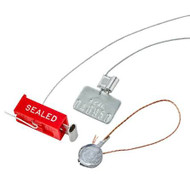
One example is the PSW-97, a wire seal invented by American Casting & Manufacturing (AC&M) with a stainless steel locking plunger. The seal can be color coded and custom marked. Stock seals are printed with “SEALED” and consecutively numbered.
For operations that routinely inspect large numbers of meters or measuring devices, self-locking seals can reduce the equipment required for installation while maintaining visible tamper evidence.
Snap Seals for Simple Hand Application
Snap seals provide another straightforward approach to securing wire-based applications. AC&M's steel snap seals can be bent and locked by hand, securing the wire without the need for a dedicated crimping press.
To remove a snap seal, the wire must generally be cut or the seal must be seriously bent. This provides visible evidence when the original closure has been disturbed.
Steel snap seals are available in galvanized or color-coated finishes. They can be supplied plain or marked with letters, images, and serial numbers. Their simple design makes them suitable for applications where quick installation and clear visual identification are priorities.
Wire-Wrapped Cup Seals for High-Value and Hazardous Applications
When stronger tamper detection is required, cup seals for screw, bolt, and wire protection provide another option for protecting access points.
These seals use a two-piece disc construction combined with wire and a hard bronze multi-point lock ring with saw-tooth edges. Once installed, the components form a compact closure that is difficult to access without cutting the wire.
Cup seals are designed for applications where detecting unauthorized access is especially important. The construction provides a strong tamper-evident closure, and removal requires cutting the wire. Only sharp metal cutting tools allow the seal to be opened, making the design useful for high-value and hazardous applications.
For critical measurement points, this combination of physical resistance and visible evidence can provide an additional layer of protection between inspections or service intervals.
Common Applications for Wire Seals
The applications for wire seals extend well beyond traditional mechanical scales. AC&M's security seals for utility applications demonstrate how wire and other tamper-evident seals can be used across metering and measurement environments.
Common applications include:
- Utility meters: Electricity, gas, and water metering equipment can use seals to indicate unauthorized access to protected components.
- Taxi meters: Wire seals can help protect meter housings and adjustment points between inspections.
- Fuel meters: Fuel dispensing and measurement equipment can use seals to help identify unauthorized access.
- Laboratory equipment: Testing and measurement devices can be secured between calibration or inspection procedures.
- Truck scales: Weighing systems used for commercial transportation can use wire seals to protect critical access points.
- Postal weighing equipment: Postal scales and related equipment can be secured against unauthorized adjustment.
- Production equipment: Filling, weighing, and measurement systems in manufacturing environments can use seals to protect adjustment points.
- Liquid delivery systems: Trucks, transfer points, and other liquid-handling equipment may require sealed metering components.
- Traffic counting equipment: Remote measurement devices can be protected with compact wire seals.
- Weather and environmental equipment: Remote weather stations and water-level monitors may use wire seals where controlled access is required.
The wide range of applications means there is no single wire seal that fits every measurement or metering device. The seal must accommodate the available attachment points while providing the appropriate level of tamper evidence.
Selecting the Right Wire Seal for Your Equipment
Choosing a wire seal begins with evaluating the equipment itself. AC&M's guide to tamper-evident security seals provides additional guidance on matching seal type, strength, closure method, and application requirements.
Consider the following factors:
- Sealing-point size: Fine-gauge or braided wire may be necessary for small openings.
- Application method: Crimp seals require a compatible press or tool, while self-locking designs can simplify field installation.
- Material: Aluminum, steel, plastic, and other constructions offer different combinations of strength, flexibility, and identification.
- Identification: Numbering, colors, and custom markings can support inspection and asset-tracking procedures.
- Tamper evidence: Basic wire closures may be appropriate for routine applications, while other designs can provide additional resistance for higher-risk equipment.
- Removal procedure: Consider whether the seal can be removed only by cutting the wire or requires additional bending or tools.
- Operating environment: Outdoor, industrial, or corrosive environments may require a material selected for the surrounding conditions.
Selecting the right seal helps organizations balance application speed, equipment compatibility, identification, and tamper evidence.
Protect Weighing and Measuring Equipment With AC&M
Weighing, measuring, and metering equipment often requires a clear indication when access has occurred. Wire seals provide a straightforward way to protect these access points, with crimp wire, self-locking, snap, and wire-wrapped cup designs available for different equipment configurations.
American Casting & Manufacturing has more than 110 years of experience producing security seals for government, utility, military, commercial, and industrial applications. Contact an AC&M seal application specialist at (800) 342-0333 for product guidance, samples, or pricing based on your equipment and sealing needs.