
Tamper Evident Seals in Law Enforcement: Protecting Chain of Custody From Evidence Room to Cell Block
Posted by Steve Diebold
In law enforcement settings, tamper evident seals can help protect the chain of custody by making unauthorized access to evidence, secured storage, or property easier to identify. These single-use security devices provide a visible indication when a sealed item or container has been opened or tampered with.
Maintaining a chain of custody requires more than choosing the right seal. Personnel also need consistent procedures for recording seal numbers, applying closures, inspecting their condition, and documenting when seals are removed from service. Serialized, barcoded, and custom-printed security seals can support these processes across evidence packaging, storage areas, property containers, and other controlled assets.
Securing Every Evidence Handoff
Every transfer of evidence or property creates an opportunity for a seal to provide an additional point of verification. Applying a serialized security seal to a package or container gives personnel an identifying number that can be recorded when the item is secured, transferred, inspected, or opened. If the seal is damaged, removed, or shows a different number than the one recorded, personnel have a clear reason to investigate the discrepancy.
Most plastic seals, tapes, and labels are indicative seals. Their primary purpose is to provide evidence of tampering rather than serve as a high-strength physical barrier. Depending on the application, security seals can help provide visible deterrence, indicate unauthorized access, and support an accountable record throughout an item's handling.
Different applications call for different seal designs. Tamper evident tape and labels can secure evidence bags, envelopes, boxes, and other packaged items. Plastic padlock seals can secure lockers, bins, cabinets, and similar closures. Pull-tight seals provide an adjustable closure for bags, containers, and other items that require a flexible locking mechanism. Cable and bolt seals can provide higher breaking strength where a more robust closure is appropriate.
For transfers, serialized and barcoded seals can also simplify identification and tracking. Recording the seal number at each stage helps personnel compare the physical closure with the corresponding custody record.
Evidence Packaging: Tamper Evident Labels and Tape
Security labels and tamper evident tapes can protect evidence bags, boxes, containers, and other packaged property by providing a visible indication of interference. Depending on the product, a label may leave a permanent VOID pattern when removed, while security tape can provide a tamper evident closure across a seam or opening.
Primary Label and Tape Configurations
- Residue labels: Leave a visible pattern or residue when removed, making an attempted opening easier to identify.
- No-residue labels: Provide tamper evidence without leaving adhesive residue on the protected surface, making them useful for applications where surface condition matters.
- Void and perforated tape: Tears irreversibly if tampered with, providing a visible indication that the closure has been disturbed.
- Custom printed labels and tape: Custom options can include logos, custom text, sequential numbering, barcodes, and QR codes.
Security tape and labels can be selected according to the surface, closure, and level of tamper indication required. American Casting & Manufacturing (AC&M) offers security tape and labels for applications requiring either residue or no-residue tamper evidence.
For electronics and other sensitive items, selecting an appropriate tamper evident closure is particularly important. AC&M's guidance on sealing computers and electronics provides additional information on options designed for these applications. Organizations can also review security tape and labels when selecting adhesive tamper evident products.
Streamlining Tracking With Barcoded Security Seals
Barcoded security seals can connect a physical seal to a corresponding record, helping personnel identify and track sealed items throughout their handling. A barcode printed directly on a seal can reduce manual transcription when personnel scan the identifying information during issue, use and application, or removal from service.
Barcodes can be incorporated into different security seal formats, including pull-tight seals, cable seals, bolt seals, and plastic padlock seals. Code 128 is standard, while Code 3 of 9 is available as a custom option to match existing scanning systems. AC&M also offers seals with sequential numbering and other custom identification options.
A Standard Barcoded Seal Workflow
- Issue the seal: Record the seal number and associate it with the appropriate item, case, or internal record.
- Use and apply the seal: Apply the closure and record when and where it was used.
- Verify during transfers: Compare the physical seal number with the corresponding record when custody changes.
- Remove from service: Record when the seal is removed and update the applicable custody or inventory record.
AC&M manufactures security seals in Plainview, New York, with options for serialized numbering, barcodes, QR codes, custom text, and logos. Organizations can review barcoded seal options to identify a format and locking mechanism suited to their application.
Access Control in Property Rooms and Storage Areas
Security seals can provide a visible indication of access to lockers, bins, cabinets, storage containers, and other controlled areas. Because many security seals are single-use devices, removing the seal provides an immediate physical change that personnel can identify during an inspection.
Plastic padlock seals are suited to applications such as lockers, bins, cabinets, carts, first aid kits, and zipper bags. Their breaking strength varies by design, allowing organizations to select a seal according to the closure and application.
Where a higher breaking strength is needed, cable and bolt seals provide additional options. Cable seals can accommodate applications requiring a more robust closure, while bolt seals are available for applications where the seal design and locking mechanism call for a heavier-duty solution.
Organizations can also combine security seals with tamper evident tape or labels when multiple visible indicators are useful. The appropriate combination depends on the container, closure, handling conditions, and level of tamper evidence required.
Securing Property With Adjustable Pull-Tight Seals
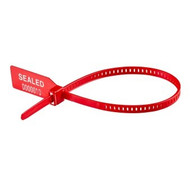
Adjustable pull-tight seals provide a flexible way to secure bags, containers, and other items with varying closure sizes. The ratchet-style locking mechanism allows the seal to be tightened around the application, while the serialized identification can support tracking and recordkeeping.
Key functional considerations include:
- Sequential numbering: Serialized seals provide a unique identifier that can be recorded and verified.
- Custom identification: Organizations can request options such as logos, custom text, numbering, and barcodes.
- Adjustable closure: Pull-tight designs accommodate applications where the size of the closure varies.
- Color options: Different colors can help organizations visually distinguish between groups of sealed items when appropriate.
Product selection should be based on the application, required breaking strength, locking mechanism, identification requirements, and whether the seal needs to accommodate a particular container or closure. Organizations can review the guide to choosing pull-up seals for additional information on plastic security seal options.
Essential Components of a Security Seal Log
A consistent seal log helps organizations connect each physical seal with its associated item, location, or activity. AC&M's security seal best practices emphasize tracking the seal through key stages of its lifecycle, including issue, use and application, and destination or removal from service.
An issue record can identify the seal number and the person or department receiving it. The use and application record can document when the seal was applied and the item or access point it secured. When the seal reaches its destination or is removed from service, personnel can document the applicable date, status, and other information needed for the organization's records.
Inventory management is another important part of a consistent sealing process. Unused seals should be stored appropriately, with distribution controlled according to the organization's procedures. Personnel can also inspect seals during custody transfers or other designated checkpoints to verify that the closure remains intact and that its identifying information matches the associated record.
When a seal is removed from service, destroying the used seal helps prevent it from being reused. Organizations should also monitor inventory levels and reorder at least six weeks before expected depletion to help maintain an adequate supply.
Consistent inspection procedures can help personnel identify damaged seals, altered identification numbers, or other discrepancies. AC&M's security seal verification and inspection guide provides additional information for organizations establishing consistent verification practices.
Establishing a Consistent Chain of Custody
A reliable chain of custody depends on both physical controls and accurate documentation. Tamper-evident labels and tapes can help protect packaged evidence, while serialized and barcoded seals make individual items easier to identify throughout handling, storage, and transfer. Plastic, pull-tight, cable, and bolt seals offer additional closure choices for different environments and access points.
American Casting & Manufacturing (AC&M) produces security seals with serialized, barcoded, and custom-printed identification, including custom text, logos, numbering, barcodes, and QR codes. Browse the security seal catalog to compare available designs, or contact AC&M to discuss the requirements of a specific chain-of-custody application.