
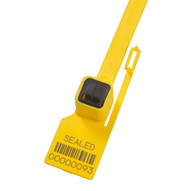
Strap Seals for Truck Trailers: Choosing the Right Security Seal
Posted by Steve Diebold
Truck trailers need a reliable way to protect cargo between loading, transit, and delivery. Fixed-length strap seals provide a simple, visible closure for trailer doors while making unauthorized access easier to identify. Available in metal and plastic designs, strap seals can accommodate different latch configurations, security requirements, and identification needs.
Strap seals have been a staple on truck trailer doors for over a century and remain the most often used seal in trucking. Modern tamper-evident security seals offer additional options such as sequential numbering, barcodes, color coding, and custom markings, helping transportation teams combine physical security with easier shipment identification.
Choosing the Right Metal Strap Seal for Truck Trailers
Metal strap seals provide a durable option for securing trailer doors and other transportation equipment. The available designs generally fall into two categories: flat metal seals that lock into a rectangular enclosure and ball-type seals with a round ball or globe on the end that locks with internal circular wires. Each design includes variations intended to accommodate different latch openings and application requirements.
When selecting a metal strap seal, consider the trailer's locking mechanism, available clearance, required level of tamper resistance, and how easily drivers need to apply and inspect the seal.
Key considerations include:
- Lock configuration: The seal must fit securely through the trailer's latch or hasp without excessive movement.
- Seal thickness: Different lock thicknesses can accommodate different applications and provide varying levels of resistance to tool manipulation.
- Locking mechanism: Flat and ball-type designs offer different approaches to securing the strap.
- Identification: Sequential numbers, markings, and barcoding on select models can help connect a seal to a specific trailer or shipment.
- Inspection: A clearly visible seal makes it easier for drivers, warehouse personnel, and receivers to identify a broken or altered closure.
AC&M's B1 and G1 ball-type seals are designed to provide greater resistance to tampering than standard flat designs. The B1 allows the band to pass through the ball, creating additional inspection points, while the G1 provides an equally effective lock at a lower cost. Among flat metal options, the FC1, FC2, FC3, and FC4 come in different widths for smaller latch openings and two lock thicknesses. The FC4 has the thicker lock body, making tool tampering more difficult.
Understanding Flat Metal Strap Seal Options
Flat metal seals are commonly used when a trailer's locking hardware provides a compatible opening for a fixed-length band. The seal passes through the latch and locks into its housing, creating a closure that should remain visibly intact when the trailer reaches its destination.
The metal seals for transportation available in different configurations can help fleets match seal dimensions and locking designs to their existing trailer hardware.
Among flat metal options, the FC4 features a deeper lock body than the thinner FC-series alternatives. This design makes access to the locking area more difficult with basic tools. The FC1, FC2, and FC3 provide effective options for deterring opening and providing evidence of tampering.
Before selecting a model, verify the dimensions of the trailer's latch opening. A seal that is too wide or too thick may not fit correctly, while insufficient clearance can make installation or inspection difficult.
Plastic Fixed-Length Strap Seals for Trailer Doors
Plastic strap seals provide a lightweight alternative to metal designs and are widely used for truck trailers, railcars, bulk tankers, totes, and other transportation applications. Their smooth edges make them safer to handle, while bold, easy-to-read markings provide clear identification.
For fleets that need greater traceability, barcoded security seals can connect the physical seal to shipment or trailer records. This can make it easier to document which seal was applied, identify a specific load, and verify the seal during receiving.
Common plastic strap options include:
- 4001: The standard-duty plastic strap seal used most widely on trucks.
- BCTS: The barcoded companion to the 4001 for applications requiring barcode identification.
- HS75 and HS115: Advanced fixed-length plastic seals featuring multi-point locking and greater pull strength for more demanding applications.
The HS series is among the most advanced, highest-quality fixed-length plastic seal options available. Plastic strap seals also offer more marking and color options than metal designs and can be supplied from stock or custom stamped.
Transportation teams can use color coding to distinguish routes, facilities, customers, load types, or other operational categories. BCTS stock colors are white and yellow, while custom colors and printing are available on request with applicable minimum quantities.
Metal vs. Plastic Strap Seals: Which Is Better?
There is no universal strap seal that is ideal for every trailer. The choice between metal and plastic depends on the trailer hardware, application requirements, environmental conditions, identification needs, and handling preferences.
|
Consideration |
Metal Strap Seals |
Plastic Strap Seals |
|
Physical construction |
Rigid metal band |
Flexible plastic strap |
|
Weight |
Heavier |
Lightweight |
|
Handling |
Durable construction |
Smooth edges for safer handling |
|
Identification |
Numbering, markings, and barcoding (select models) |
Large marking areas, colors, and barcodes |
|
Trailer applications |
General use; ball-type models for greater tamper resistance |
General and heavy-duty transportation applications |
|
Customization |
Available |
Broad color and marking options |
|
Inspection |
Visible physical closure |
Visible physical closure and clear identification |
For transportation operations that prioritize a lightweight design, safer handling, and highly visible identification, plastic may be preferable. Metal may be a better fit when the trailer's locking hardware or application calls for a more rigid seal. Ball-type metal models can also provide greater resistance to tampering.
How Strap Seals Improve Trailer Security
A strap seal does more than close a trailer door. It provides a visible reference point that can be checked before a vehicle leaves a facility and again when it reaches its destination.
A basic trailer-sealing procedure can include:
- Record the seal number: Document the seal assigned to the trailer and shipment.
- Inspect the latch: Make sure the trailer door is fully closed, and the seal is correctly positioned.
- Apply the seal: Secure the strap through the designated latch or hasp.
- Verify the identification: Confirm that the seal number or barcode matches the shipping documentation.
- Inspect at handoffs: Drivers, warehouse personnel, and receiving teams can check the seal for visible damage or alteration.
- Document discrepancies: A broken, missing, or mismatched seal should trigger an inspection before cargo is accepted.
Using a consistent procedure makes the seal part of the overall chain-of-custody process rather than treating it as a standalone closure.
When to Use Barcoded and Color-Coded Strap Seals
Transportation operations handling large numbers of trailers can benefit from seals that provide more identification information than a basic serial number. Custom security seals can incorporate features such as colors, sequential numbering, logos, and other identifying information.
Barcodes can connect individual seals to digital records, while colors can provide an immediate visual reference. For example, a fleet could assign different colors to specific facilities or shipment categories while retaining a unique serial number for each seal.
These features can help teams:
- Verify that the correct seal was applied.
- Match physical seals with shipping records.
- Identify unauthorized seal substitutions.
- Speed up visual inspections.
- Improve documentation at transfer points.
- Support investigations when a shipment arrives with a compromised seal.
For high-volume transportation operations, combining visible identification with serialized records can make trailer inspections faster and more consistent.
Secure Truck Trailers With the Right Strap Seal
The right strap seal should match the trailer's latch configuration, required tamper resistance, handling needs, and identification requirements. Seal material, lock design, dimensions, marking options, and application conditions should all be considered before selection.
American Casting & Manufacturing offers metal and plastic strap seal configurations for truck trailers and other transportation applications. Evaluating the actual trailer hardware and sealing requirements before purchase can help ensure the selected product provides the right combination of durability, ease of handling, identification, and tamper evidence. For assistance selecting a seal, contact an AC&M seal application specialist at (800) 342-0333.