
Choosing the Right Security Seal: Why the Strongest Option Isn't Always Best
Posted by Steve Diebold
Choosing a security seal involves more than comparing strength ratings or selecting the most expensive option. The right seal should match the application, fit the closure, and provide clear evidence of tampering. However, even a suitable seal may not prevent losses without proper handling procedures and employee accountability.
A real-world example involving a pre-mixed concrete supplier demonstrates why stronger seals are not always the answer to security problems. By examining the circumstances behind recurring cargo losses, the company discovered that improving delivery procedures and monitoring practices could be more effective than investing in more expensive security products.
A Concrete Delivery Problem That Called for a Practical Solution
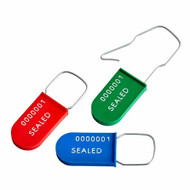
During a visit to a supplier of pre-mixed concrete, American Casting & Manufacturing (AC&M) learned about a recurring problem involving missing cargo. The company transported concrete in mixing trucks with capacities of approximately 8 cubic meters (10 cubic yards). After loading, employees secured the trucks' discharge levers with Model 1001 plastic padlock seals.
The Model 1001 was a practical choice for this application. It’s a lightweight plastic seal that can be applied without tools and removed by hand using its notched hasp. Its simple design also makes it relatively easy to inspect for visible signs of damage or tampering.
However, the conversation with the owner revealed a larger problem. Some drivers were breaking seals and diverting portions of their loads to friends or family members in exchange for money. By the time the trucks reached their intended destinations, only about 80% or 90% of the original loads sometimes remained.
When customers questioned the short deliveries, drivers reportedly blamed accidental seal damage or disputed the customers' accounts. Management also suspected that some drivers were attempting to reattach broken seals to make them appear intact. These incidents gradually undermined customer confidence in the supplier.
Why a Stronger Seal Wasn't the Best Answer
The owner asked whether a stronger seal would prevent further losses. Before recommending a replacement, the first consideration was who had access to the trucks and their cargo. The owner confirmed that the drivers were company employees rather than independent contractors.
That distinction mattered. A stronger seal can make unauthorized access more difficult, but it cannot eliminate the risk of deliberate tampering by someone with access to the vehicle, tools, and time. Even a heavy-duty seal can be cut or damaged, and someone attempting to conceal the breach may try to make the seal appear intact.
A higher-strength option would also need to fit the truck's discharge lever. Not every bolt seal or heavy-duty cable seal is compatible with every closure. Purchasing a more expensive product without first confirming its suitability could increase costs without resolving the underlying problem.
Ultimately, the issue was not simply seal strength. It was the lack of a reliable process for documenting deliveries, checking seal condition, and holding drivers accountable. Reviewing the available bolt seal options would only be worthwhile if a different seal addressed the specific application and its security requirements.
Strengthen Delivery Procedures and Employee Accountability
Rather than immediately replacing the existing seals, the recommendation focused on establishing clear delivery and inspection procedures. The supplier could reinforce its existing security measures by introducing written rules, requiring drivers to acknowledge them, and making the procedures visible to employees.
Practical measures included:
- Show the correct seal on the receipt: Include a photo on the delivery receipt showing how the seal should appear on the discharge lever, so the customer can compare it before unloading.
- Have customers witness and sign: Require the customer to sign the delivery receipt confirming that the driver broke the seal in their presence and that it was intact beforehand.
- Return the removed seal: Require drivers to submit the broken seal with the signed delivery receipt. This creates an additional record that can be compared with the delivery documentation.
- Investigate discrepancies: Partial deliveries, missing seals, or seals showing signs of tampering should trigger an internal review. The company should establish clear consequences for employees found diverting cargo or deliberately interfering with security seals.
- Preserve questionable seals: Retain any seal that appears altered or reattached so it can be examined if needed.
These procedures create a more consistent record of what happened between loading and delivery. They also make it harder to dismiss missing cargo or damaged seals as routine mistakes without further review. Consistent use of tamper-evident security seals is most effective when supported by clear inspection and documentation practices.
The Outcome: Better Security Without a Costly Upgrade
The supplier followed the recommendations, introduced written procedures, and communicated the new expectations to its drivers. The company did not need to purchase a more expensive seal to improve its loss-prevention process.
Many of the recurring delivery discrepancies were resolved, and no questionable seals required further examination. The experience demonstrated that a practical security solution does not always require a stronger or more expensive product. In some applications, better documentation, consistent inspections, and employee accountability can make a greater difference.
When a seal is suspected of being tampered with, its condition may also provide useful evidence. A cut, damaged, or altered seal can be retained for examination, helping the company investigate what happened rather than relying solely on conflicting accounts.
Choosing Security Seals Based on the Application
The concrete delivery example illustrates why seal selection should begin with the actual security concern. A seal needs to fit the closure, provide the appropriate level of tamper evidence, and support the procedures used to monitor the secured item.
When evaluating security seals for different applications, consider the following factors:
- Closure design: Check the size, shape, and configuration of the locking point. A seal that does not fit properly cannot provide the intended protection.
- Required strength: Determine the level of physical resistance needed for the application. A heavier-duty seal may be appropriate for certain transportation and cargo requirements, but greater strength is not automatically the best solution for every use.
- Removal method: Consider whether the seal should be removable by hand or require a cutting tool. The removal method should suit the inspection and delivery process.
- Tamper evidence: Choose a design that makes damage or unauthorized access reasonably easy to identify during routine checks.
- Identification: Sequential numbering, barcodes, and custom printing can help distinguish individual seals and connect them to delivery records or inventory documentation.
- Operating procedures: Establish who applies the seal, who checks it, how its identification is recorded, and what happens when a seal is missing or damaged.
A suitable seal should support the broader security process rather than be expected to prevent every form of unauthorized access on its own.
Get Guidance on Selecting the Right Security Seal
Selecting an effective security seal requires understanding the application, the closure being secured, and the risks involved. A more expensive or higher-strength product is not necessarily the right choice if it does not fit the equipment or address the underlying security concern. Combining an appropriate seal with consistent handling, inspection, and documentation procedures can provide a more practical approach to loss prevention.
With a history dating back to 1910, American Casting & Manufacturing helps businesses evaluate their sealing requirements and compare suitable options. If you need help choosing or using security seals, contact a seal application specialist at 516-349-7010, or email info@seals.com.