
Why Redundant Sealing Is Essential for Protecting Bulk Containers and Liners
Posted by Steve Diebold
Bulk transportation of high-value materials demands more than basic containment. Across industries such as chemicals, pharmaceuticals, food production, and mineral processing, products are often stored in drums or totes lined with protective plastic or rubber liners. These materials are not only valuable but also highly sensitive to contamination, making tamper evidence a critical part of quality control and regulatory compliance.
While outer container seals provide an important first layer of protection, they are not always enough on their own. Real-world handling conditions introduce risks that can compromise external seals, making redundant sealing strategies essential for maintaining product integrity throughout the supply chain.
The Limits of Single-Layer Sealing in Bulk Transport
Drums and totes are designed with designated sealing points, typically on locking rings or lid closures, where tamper evident seals are applied to confirm that the container has not been opened. Under normal conditions, these seals provide a reliable indication of access.
However, bulk containers are rarely handled under ideal conditions. They are constantly exposed to real-world stresses, including mechanical lifting and handling by equipment, stacking and shifting during storage, long-distance transportation by truck or rail, and continuous vibration and impact during transit. During these processes, seals or even the container's locking mechanisms can become damaged or dislodged. When this happens, the ability to verify whether the contents were accessed is lost entirely.
Even when stronger options like metal cable seals are used, the integrity of the system still depends on the condition of the container. If the locking ring or seal attachment point fails, the seal becomes irrelevant. This creates a significant vulnerability, especially when dealing with materials that must meet strict purity or safety standards. For a closer look at how outer drum seals are typically applied, the overview on securing bulk drums and the seals used covers the most common configurations.
Redundant Sealing as a Second Layer of Assurance
To address this risk, many bulk liner systems are designed with excess material at the top, allowing them to function as sealable inner bags. This design enables a second sealing point that operates independently of the outer container. It creates an additional layer of control that remains unaffected by external damage.
Twisting and securing the liner with a dedicated seal creates a redundant layer of tamper evidence. If the external seal is compromised during transit, the inner seal remains intact and continues to provide proof that the contents have not been exposed. This ensures that product integrity can still be verified even under uncertain conditions.
This dual-layer approach significantly reduces the likelihood of product loss. Instead of discarding or reprocessing entire shipments due to uncertainty, organizations can rely on the inner seal as verification of product integrity. It also supports more efficient operations by minimizing unnecessary delays and additional handling. AC&M's dedicated page on redundant sealing to protect bulk products with liners provides further detail on how this approach works in practice.
Choosing Seal Types That Work for Liner Closures
Selecting the right seal for liner-based applications requires more than a basic fit. The seal must perform consistently under movement, pressure, and varying storage conditions while maintaining a tight and reliable closure.
Key considerations when choosing the right seal:
- Secure Holding Strength: The seal must create a firm closure that keeps the liner tightly cinched without loosening over time.
- Slip Resistance: Features such as gripping teeth help prevent the seal from sliding or backing out after installation, especially during transport.
- Durability Under Movement: Seals should maintain integrity even when exposed to vibration, handling, and shifting loads.
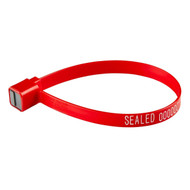
- Ease of Application: In fast-paced environments, heavy-duty strap seals like the PS360 and DTZIP pull-up seals allow quick, tool-free installation while maintaining consistency.
AC&M's pull-up seal options are specifically designed to meet these requirements, making them highly effective for bag-style liner closures. For guidance on getting the most out of these models, the step-by-step guide on how to correctly use and securely lock a bag seal is a practical reference. For a broader comparison of available options, reviewing the full range of tamper evident security seals can help teams identify the most suitable solutions for their application.
A well-chosen seal not only secures the liner but also ensures that tamper evident markings remain clear and reliable throughout the entire supply chain.
Material Selection and Its Impact on Product Integrity
In applications where product purity is critical, the seal material is just as important as its locking function. Sealing solutions must not only secure the closure but also support cleanliness and stability throughout storage and transport. This is where material choice directly influences overall product integrity.
Nylon-based sealing solutions offer clear advantages in these environments. AC&M's printed nylon cable ties with stainless steel locking tabs are engineered for both durability and consistency. Unlike some plastics, nylon resists cracking, drying, and long-term degradation, allowing it to maintain performance even under temperature fluctuations and extended storage conditions.
Equally important, nylon does not shed microscopic particles. This helps protect sensitive contents such as food products, pharmaceuticals, and fine chemicals from contamination, ensuring that the seal itself does not become a risk factor in maintaining product quality.
Industries That Rely on Dual-Layer Sealing Protection
Redundant sealing strategies are particularly valuable in industries where both product value and contamination risk are high, especially when using tamper evident seals to maintain clear verification of product integrity.
Common use cases include:
- Food ingredients and additives requiring strict purity control
- Pharmaceutical materials with regulatory compliance requirements
- Chemical products sensitive to environmental exposure
- Bulk minerals and industrial materials with high resale value
In these environments, the ability to verify product integrity, even if the outer seal is compromised, can prevent unnecessary waste and reduce financial losses. For teams evaluating which seal formats best fit these conditions, the comparison of 3 types of seals for bulk drum security is a useful starting point for narrowing down options.
Reinforcing Bulk Protection with Redundant Sealing
Bulk shipments face real-world handling conditions that can compromise even well-applied outer seals. Relying on a single sealing point creates unnecessary risk, especially for high-value or contamination-sensitive materials, where integrity verification is critical. Damage to locking components or seal points can occur at any point during transit, making it difficult to confirm that the contents remain fully protected.
A second sealing layer at the liner level provides more reliable protection. This approach preserves tamper evidence even if the outer seal is damaged, helping reduce product loss and avoid costly reprocessing. American Casting and Manufacturing supports these strategies with solutions designed for consistent, real-world performance, from the PS360 and DTZIP strap seals purpose-built for liner closures to nylon ties engineered for sensitive product environments. It also strengthens quality assurance by adding a clear and reliable backup verification point.